Finding a building plot – Consider demolish and rebuild
In many parts of the UK, buying a building plot with a view to demolishing and rebuilding a house is often a cost-effective solution. This is especially the case in areas where individual building plots are rare. Here we look at the pros and cons of demolish and rebuild when it comes to finding self build plots.
1. In what circumstances does the local planning authority allow a house to be replaced on a building plot?
Key markers are properties that are rundown, too small for the size of their plot or incongruous in the street scene. For example, an ugly 1970’s property in a pretty historic village or a bungalow on a street of houses. Ideally the property should still be occupied, or recently occupied, so the house is considered to be in residential use. Each council sets out their own policy regarding replacement dwellings. Make sure you check the details for the area you’re interested in before buying a building plot.
2. Which properties should be avoided?
When buying a building plot remember there are restrictions to properties in conservation areas, Areas of Outstanding Natural Beauty, green belt and National Parks – and listed buildings are not allowed to be demolished. Restrictions can apply to old houses too, even if they’re in a poor state. The Bowden’s discovered their rundown cottage was considered too historically important to be demolished. They settled for two oak frame extensions instead – resulting in a much better solution all around. Find out more about the Bowden’s project here .
3. Can the new house be bigger than the original property?
There’ll still be restrictions on volume, mass, bulk and size so there won’t be a complete free-rein on design. Broadly, planners want the new house on the building plot to sit comfortably within its surroundings and be no more obtrusive than the original. Often this means sitting the replacement house on the same footprint and with a similar ridge height. Opportunities to increase the space can be sought by putting rooms in the roof, applying to build a basement, including the footprint of existing outbuildings, and extending the original space within permitted development rights.
4. Does the new house on the building plot have to look like the old one?
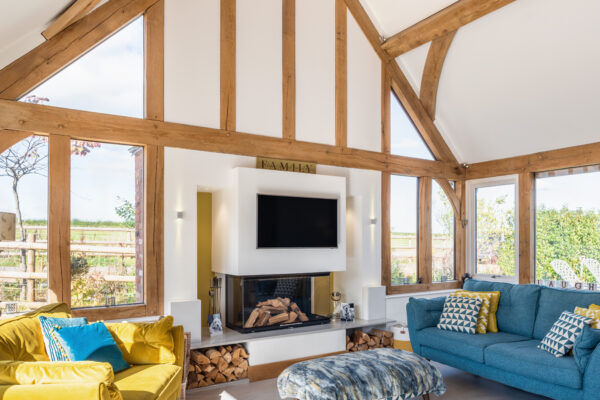
Not necessarily, it’s more important the appearance fits in with the surroundings of the building plot. Have a look at the architecture in the local area and find examples that justify your own design. For example, a village with a number of old timber-framed cottages sets a good precedent for a new oak frame build.
5. Can the new house be relocated on the building plot?
It depends. Some councils want the street scene to look the same as it did before, even if the decision seems odd. You may decide moving the house means reducing its visual impact, improving the safety of the road, and taking advantage of views and light. If you need to live in the old property while the new one is being built, then put this information in your application.
6. Is it expensive to demolish a house?
You may need to pay for a license to close the road so a crane can access the building plot. Disposing of the materials accounts for a large proportion of the demolition bill. Re-use materials where you can in landscaping, and if there’s anything worth salvaging, you may get a reduction on the price. Asbestos needs a specialist contractor. You might need to do a wildlife survey before you start if the property is in a rural area. Any evidence of endangered species, like bats for example, will need to be addressed before demolition begins on the self build plot. Above all, don’t demolish a house until you have planning permission to replace it with a new one.
7. Is it worth keeping the existing foundations to save money when demolishing and rebuilding a house?
Yes and no. When demolishing and rebuilding a house, building foundations uses a significant chunk of a build budget but you won’t necessarily save money if you keep the old ones. The council will consider the project to be a renovation rather than a new build. This means 20% VAT applies to the whole project instead of being zero-rated.
8. Is the house/building plot too expensive?
If you want to make a profit, or at least break even, crunch the numbers first. You need to have a rough, but realistic, idea of the total build cost (including demolition on the building plot) and an understanding of the value of the new house when it’s finished. If the old property is going to auction, sealed bids or there’s room to negotiate then this will give you a sensible indicator of how much to pay. In theory you want to be building a bigger house on the self build plot than the one you’re replacing.