

Building your own oak frame home or extension creates a fantastic opportunity to live in a warm and comfortable house, so why not make your energy bills as low as possible while reducing the impact on the environment at the same time? Of course the beauty of constructing in oak is that it’s inherently a naturally sustainable material.
Reduce carbon emissions
Reduce carbon emissions by looking at all stages of the house lifecycle. Oak is a great starting point because trees clean our air by absorbing CO2 and releasing oxygen. Oak locks away the stored carbon until its burnt or naturally decays. Welsh Oak Frame only buys oak from sustainably managed forests with Forest Stewardship Council (FSC) or the Endorsement of Forest Certification (PEFC) accreditations to guarantee more trees are grown than cut down. Processing oak uses less energy than concrete and steel and is prepared in our workshop to a precise design so there’s minimal wastage. Once on site, the frame is put together by hand with traditional framing methods and off-cuts are often recycled for fuel. During your project, avoid long distant transport costs by buying local and using local trades, and install renewable technologies (see below) to supply every day energy needs.
Passive solar design
Passive solar design orientates the house to harness the sun’s natural energy, light, heat and ventilation for comfortable living and less energy use. For example, utility and bathrooms are best placed on the cool, darker north side of a house. South-facing windows draw in winter sun to warm rooms and are designed with an overhang or awning to protect from overheating in summer. In a large, glazed room, windows opposite one another can provide a cooling cross-breeze. Get into the detail by commissioning a specialist solar survey that tracks the sun’s path throughout the day. For more advice, chat to our in-house design team.
Energy efficient materials
Energy efficient materials go hand in hand with energy efficient design. Together, the ‘fabric-first’ approach prioritises a property’s thermal performance to minimise daily energy use. A highly insulated roof and walls are key and oak is a natural insulator thanks to air pockets that reduce heat loss. An oak frame can be infilled with high performing insulation, which exceeds Building Regulations. Another option is to wrap the outside of the frame in structural insulated panels (SIPs) to form a high-performing thermal envelope. Roofs can also be insulated with SIPs or sustainable options such as sheep’s wool, wood fibre or cellulose made from recycled paper. Look for thermally-efficient windows and doors with low u-values and a high energy rating, considering triple-glazing and Low-E coatings that reflect heat back into the house. As before, timber frame is the most sustainable material. In all cases, make your home airtight by taping all joints to prevent heat loss.
Renewable energy technologies
Renewable energy technologies replace fossil fuels. Solar photovoltaic panels (PVs) installed on the property or garage roof generate electricity from the sun. It’s also possible to store excess energy in a battery or export to the national grid. Solar thermal panels absorb the sun’s energy to heat a fluid that in turn heats up water in a thermal store. The hot water supplies the home and can be run through underfloor heating pipes, which radiate heat upwards to keep the home an even temperature. A heat pump does the same, extracting heat from the ground or air and is run by electricity generated through solar PVs. Optimise renewables with smart home technology that allows you to programme and control heating, lighting and cooling needs.
Environmentally friendly living
Environmentally friendly living aligns with oak frame houses because the exposed frame won’t emit harmful chemicals. Use non-toxic paint for decorating and natural flooring like stone and wood. Buy energy efficient appliances and save water with low-flow taps and showers. A rainwater harvesting system can be used to flush toilets, wash the car and irrigate the garden.
An oak frame house has longevity if it’s designed and built by experts as proved by oak frame buildings still standing after many hundreds of years. Oak is strong and durable. As the green oak dries, the natural shrinking and splitting tightens and strengthens the frame. Oak has a natural resistance to insects and rot and won’t need oiling or varnishing on the exterior but will naturally weather to silver over time.
Be inspired
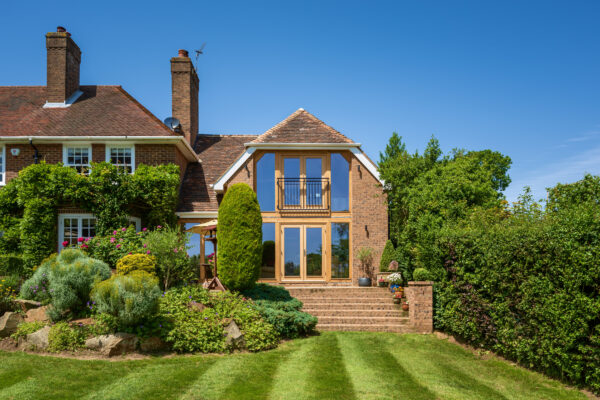


Handcrafted excellence
We have spent many years perfecting the art of handcrafting the best oak frames in the business. We are one of the very few oak framing companies that still truly handcraft our oak frames. This results in a more impressive oak frame, full of striking details that are not possible to achieve with a machine made frame. Our oak frames are infused with a more natural feel, free from ridged lines and angles.


