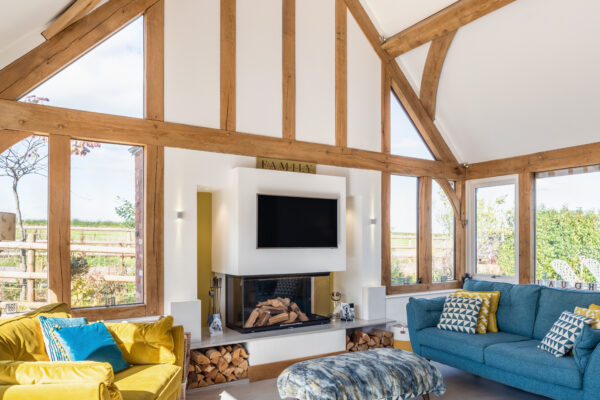

How to achieve a bespoke oak framed extension on a budget
Many homeowners see oak framing as a luxury option. You might be surprised to know that this route isn’t out of reach if you are on a modest budget. There are several clever ways you can keep prices down and still achieve the oak frame extension of your dreams.
Do your sums first and then cut costs
It can be easy to get carried away with all the possibilities for your new oak frame extension. Take a moment to step back and have a look at how much value it will add to your home. Your priorities may be different if this is your forever home. As a rule, try not to spend more on a property update than its finished value.
Before you consider what you need to trim off your oak frame extension budget, work out exactly how much you need to spend to get the extension you want. This should include the interior fit-out costs. Then, when you’re happy it can be achieved, go to a local estate agent and ask how much your home might increase in value with your proposed project in place. Ideally, your oak frame extension should add more to your home’s value than it cost.
Keep the oak frame extension design simple
The complexity of design is one of the biggest factors affecting build costs. Sticking to a simple configuration, e.g. a rectangle with a pitched roof, will work out cheaper than a more complicated design.
The more corners introduced into a design, the higher the price tag. A simple design with minimal corners is cheaper to build. It’s easy to get carried away when you see what has been achieved with those with deeper pockets such as wide spans, feature trusses and glazed gables. It’s important to stay disciplined and look for other ways to create the wow factor. The beauty of an oak frame is that by nature of the product, you are guaranteed a characterful oak frame extension, even if you build something very basic.
Work with an experienced oak frame extension designer
Oak frame is a specialist method. It is not as well understood by generalist architects and builders in comparison to some other routes.
It is essential and generally more cost-effective that you choose an architect/designer who understands oak framing. This can help avoid issues right from the start. It will ensure that you make the most of the oak framing structurally, aesthetically as well as taking into consideration scale and proportions.
Be open about your budget
Being open about your budget from the start will enable your oak frame extension designer to design an oak frame extension to your budget. Clients who are open about their budget makes it easier for us to keep within it and we can show how simple (on the face of it) additions to a design can often have a huge knock-on effect to price.
Choose standard materials, fixtures and fittings
One of the key reasons why oak frame extensions tend to cost more is that people look to match the highly-crafted frames with good quality products, such as handmade bricks and roof tiles. If you want luxury, you can expect a price tag to match.
Choosing more standard materials, fixtures and fittings will reduce your costs considerably.
Don’t be enticed by fashionable brands when more affordable own-brands or DIY-store products will do the job just as well. Dulux paint, for example, will do as good a job, if not better than expensive, trendy paints that cost twice the price. You can still create that luxurious look and feel on a budget by being a savvy shopper.
Get the timings right
Whether you are project managing or just ordering your own materials to save money, getting the timings of deliveries right to save on wasted labour costs is vital. A site with no one working on it is costly, so materials need to arrive in plenty of time.
Consider positions and placements carefully
Simplifying the groundworks will help reduce costs. This might mean opting to site your extension away from trees, drains, sewers or other buried services – obviously, this will depend on whether you have the space to be choosy.
Consider the position of fittings inside the new extension, too. If, for example, a new toilet can be sited near an existing soil stack rather than at a distance from it, you’ll save on labour and material costs.
Stick to your plans to keep costs down for your oak frame extension
Carefully planning the design of your extension, right down to the specification and position of the light sockets, will save you money on making costly changes later on when the build has already started.
Sticking to those design details as closely as possible will keep costs under control, as changes always incur a charge.
Re-use materials
Working out if you can re-use existing materials should be very much part of the extension design planning process. This may mean re-using your existing kitchen or re-purposing it as fittings for a new utility room. Perhaps you can refinish and re-lay old floorboards.
If you are knocking down an existing structure, you may be able to reuse stone, bricks and tiles. Another way to save is to buy reclaimed materials from private sellers on the internet or from salvage yards. You can grab yourself some real bargains. Also these individual finds are likely to add more character to your new extension, too.
Sell what you don’t need
If you are replacing an existing structure and can’t re-use existing materials sell them rather than letting your builders put them on a skip. Reducing skip usage means lower skip hire costs. As a private householder, don’t forget that you can use your council tip for free, too.
Be your own project manager for your oak frame extension
If you have the time – and it does take lots of it – project managing the building work yourself will save you the fee your builder will charge to cover their time. This is usually 15-25% of the total cost of labour and materials.
If you are project managing – or buying materials yourself – it’s worth finding out if your local builders’ merchant will offer you wholesale/trade prices. Alternatively, your builder may allow you to use their trade account. This will enable you to take advantage of their trade discount. You will need to pay the supplier directly. Bulk-buying from one supplier is a good opportunity to ask for a further discount. You will also reduce delivery costs too.
Save on VAT
If you take on self-employed tradespeople who turn over less than the VAT threshold, you won’t be charged this tax. This will make your labour costs lower. Bear in mind, too, building an extension on a house that’s been empty for two years or more, can be done at a reduced VAT rate.