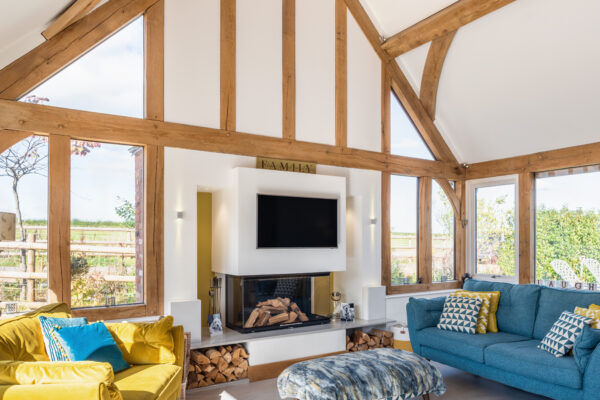
What is green oak? Why it’s used in oak frame construction
What is green oak?
Green oak is freshly felled oak that has not been dried before it is cut and used. “Green” refers to its high moisture content, not its colour. When an oak tree is felled, its timber can hold up to 80% moisture.
Green oak is the traditional material for oak frame buildings in the UK. It is softer and easier to work than dried oak, and it is available in the large sections needed for posts, beams and trusses. As it dries in the finished building, it shrinks, tightens its joints and becomes harder and stronger.
In short: green oak is unseasoned oak, used fresh because it is easier to shape, more affordable in large sizes, and it locks the frame together as it dries.
Why is green oak used for oak frame houses?
Green oak is the best choice for structural oak frames because it is easier to shape, available in large sizes, and grows stronger as it dries. The main reasons are:
- It is easier to work. Freshly felled oak is softer, so carpenters can cut and shape it accurately by hand, including the intricate joints and details a traditional frame needs.
- The joints tighten over time. As green oak dries, it shrinks mostly across the width of the grain. This pulls the pegged mortice and tenon joints tighter, making the frame more rigid.
- It gets harder and stronger. Oak becomes denser and harder as it loses moisture, so the frame strengthens in the years after it is built.
- Large sections are practical. Big posts and beams can take many years to dry right through, which makes air-dried oak in structural sizes rare and expensive. Green oak makes large oak frames affordable.
This is why green oak is used for oak frame homes, extensions, roof trusses, beams and posts.
Does green oak shrink and split?
Yes. Green oak shrinks and develops cracks, known as “shakes” or “checks”, as it dries. This is a normal part of how oak behaves and is not a defect. Most shrinkage happens in the first 24 months after the frame is built.
The drying happens in stages:
-
-
- At felling, the timber can hold up to 80% moisture.
- Free water leaves first. The timber loses the water held in its cell cavities. This causes little or no shrinkage.
- Fibre saturation point (around 30%). Once the free water has gone, the cell walls begin to dry. This is when shrinkage starts.
- Settled indoors, dry oak can reach a moisture content as low as 8%.
The outside of a beam dries faster than the core, and this difference causes the surface cracks. The splits do not weaken the frame. The timber is becoming harder and stronger as it dries, and many owners come to love the character the cracks give.
The most noticeable effect inside a home is usually small gaps between the oak frame and plastered infill panels. These are easy to fill during routine redecoration.
Green oak vs air-dried oak vs kiln-dried oak
Green oak is best for structural frames, air-dried oak suits visible work where less movement is wanted, and kiln-dried oak is for joinery, flooring and furniture.
Green oak vs air-dried oak vs kiln-dried oak Green oak Air-dried oak Kiln-dried oak How it’s prepared Used soon after felling Left to dry naturally outdoors, often for years Dried in a heated kiln Moisture content High, up to 80% at felling Lower, varies with time and climate Low, around 10–12% Movement after use Shrinks and cracks as it dries Some movement Very little Ease of working Softer, easiest to cut and shape Harder Hardest Cost in large sections Most affordable Expensive Rarely available in structural sizes Best for Oak frames, posts, beams, trusses Feature beams, porches, cladding Doors, windows, flooring, furniture As a rough rule of thumb, oak air-dries at about 25mm (one inch) of thickness per year. That is why a large structural beam is almost always used green.
How Welsh Oak Frame builds with green oak
Welsh Oak Frame has been designing and handcrafting green oak frames nearly 30 years. Our designers plan for shrinkage and movement from the first drawing, so the frame stays sound for its whole lifetime.
We are one of the few oak frame companies that still truly handcraft our oak, rather than relying on mass timber processing machinery. Working green oak by hand lets our carpenters create the detailing and features that machines cannot.
Want to see how green oak looks and weathers in a finished home? Visit our show home, read about our handcrafting methods, or explore your design options.
Green oak FAQs
Why is it called green oak?
“Green” means the oak is freshly cut and still full of moisture. It has nothing to do with the colour of the wood.
How long does green oak take to dry?
Most shrinkage happens in the first 24 months after building. Large sections keep drying slowly for many years, but movement after the first two years is minimal.
Do the cracks in green oak weaken the frame?
No. Cracks are a natural result of drying and do not affect the frame’s strength. The oak becomes harder and stronger as it dries.
Is green oak strong enough to build a house?
Yes. Green oak has been used for structural frames for centuries, and many medieval oak framed buildings still stand. Modern frames are also checked with structural calculations.
Can green oak be used outside?
Yes. Oak is naturally durable and weathers to a silvery grey if left untreated. It is widely used for porches, garden rooms and external frames.
Is green oak cheaper than dried oak?
Yes, especially in large sizes. Drying big beams takes years, so air-dried or kiln-dried oak in structural sections is much more expensive and harder to source.
-