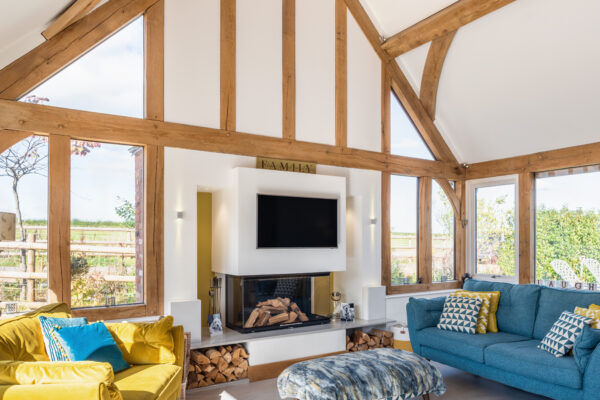
How do I design my own home?
If you are about to start planning your new self-build’s look, feel and layout, there are a number of areas to consider to ensure you create a successful modern house design. Here’s our 10 top tips for modern house design success from our team of expert oak frame designers.
1. Think about the plot
Your plot will have a big impact on the design of your home. Coming up with a design before you have purchased a site will not only make it harder for you to find land in the first place, but it will prevent you from utilising a key element of great house design – making the most of the location.
Depending on where your site is, you may want to select materials and finishes that are suited to the local vernacular – and your planning department may have restrictions, so bear this in mind. In terms of orientation, you’ll want to make the most of the surrounding views, so you’ll have to position the house to look over the garden or countryside beyond. There may be physical issues to consider, too – is the plot sloping? If so, you need to work out how to incorporate this into the layout. This could affect the room arrangement as well as positioning of windows and doors. Other issues such as ground conditions and accessibility may affect your plan, too.
2. Work with natural light
Knowing the suns route across your plot is a valuable piece of information. This will help you to understand how light will move around your house during the day and throughout the year, if you utilise this as a design feature your home will be as naturally bright as possible. A home filled with sunlight is cheery, warm and inviting, what’s more an abundance of daylight has both physical and emotional health benefits. Also, having a good amount of natural light will reduce the need to turn on lights during the day, which will help to cut your energy consumption.
Rather than cramming in as many windows and skylights as possible, it’s important to balance sunlight’s benefits with its side effects: heat gain/loss and glare. These elements can be controlled with proper window placement and orientation, shading techniques and energy-efficient glass.
3. Gather your ideas
To get the most out of your oak frame design professional, they need to really understand your preferences and requirements. A great starting point is to log your ideas, which you can do by creating a scrap book or photo album, for example, or go online and create a Pinterest board.
Self-build magazines are an excellent source of ideas as well as the internet – inspiration can come from anywhere. You may pass a property that you like the look of, take a photo and add this to your collection. As well as recording things you do like, it is worth keeping a file of things that you don’t. This kind of documentation will really help your designer to avoid these elements and reduce the potential of the frame designer creating something that misses the mark.
4. Give a clear brief
The success of any home rests on the quality of your initial brief. The most important contributor to creating a great house design is you. Having a clear idea of what you want from the project is vital to its success. We are not suggesting you draw up designs or sketches, however if you want something that suits your lifestyle, then its important to identify what your needs are from the outset.
Having a list of priorities in advance will help to convey what you are trying to achieve. Remember you don’t need to work out every detail, rather consider elements such as whether you want open-plan or cosy closed-off areas? Do you like lots of glazing? Do you have a list of key features, such as a fireplace or vaulted ceilings?
5. Decide on your build system
Your choice of construction method should be one of the first decisions you make. This will have implications on practically every level of your project including your design, costs, build speeds and energy efficiency. If you already have a design that doesn’t include an oak frame, our team of frame designers can work with your plans and design in the oak frame where possible.
6. Work with a home design specialist
It is essential that choose your design professional carefully. Seeking someone who has extensive knowledge of both the construction process and your chosen build system will avoid problems further down the line.
Engaging with specialists in your chosen build method, whether you use the design services of an architect or of a manufacturing company, will have a positive impact on your design and ultimately the finished project.
7. House design to your budget and spend wisely
Being clear and open about your budget from the outset will ensure your designer creates a modern house design that is affordable. Also, when considering your brief your designer should create something where funds are spent according to the list of priorities set by you. As the house plan evolves there may be a number of trade-offs that you have to make to stay within budget.
8. Understanding and visualising the house design plans
Once your designer has drawn up some plans and elevations, it’s important that you understand and visualise them in 3D. All good designers think in 3D from the moment they start creating a home. Most self-builders do not have this skill. Technology has moved on a great deal since the cardboard models traditionally used by architects. If you are having problems understanding the drawings, illustrative sketches or fully interactive 3D models can be produced. These create a virtual walk-through so you can visualise, explore, adjust and refine every last detail of your modern house design. Spending time on getting the design right is time very well spent.
9. House design details
Although the structure and layout of your home is of upmost importance, the interior fixtures and fittings are essential too. You’ll be in close contact with every last detail including ironmongery, floor coverings etc. You need to decide who will be specifying them? Will it be you, your architect or your project manager? Whoever it is, it’s essential that you are heavily involved to ensure the quality of the products match your requirements, expectations and personal taste.
10. Be open-minded
If a design doesn’t seem to be working the answer might be to change the brief or even scrap the original idea all together. This can be quite difficult, especially when a lot of time and effort has already gone into it. Sometimes moving rooms around, flipping the plan to a mirror image or even removing areas can often result in a more successful design.
Remember, to even get to this point your designer will have learnt a great deal about what important features you desire and what compromises you are willing to accept, so it’s certainly not time wasted. Also remember that at this point, changing plans is low risk as they are merely just drawings. Making changes further down the line, when the physical build has started, could be extremely costly and waste time.